Speed to Lead in Real Estate: What the First Five Minutes Change
Why a lead answered in five minutes behaves differently from the same lead answered the next morning, and what the first message actually needs to contain.
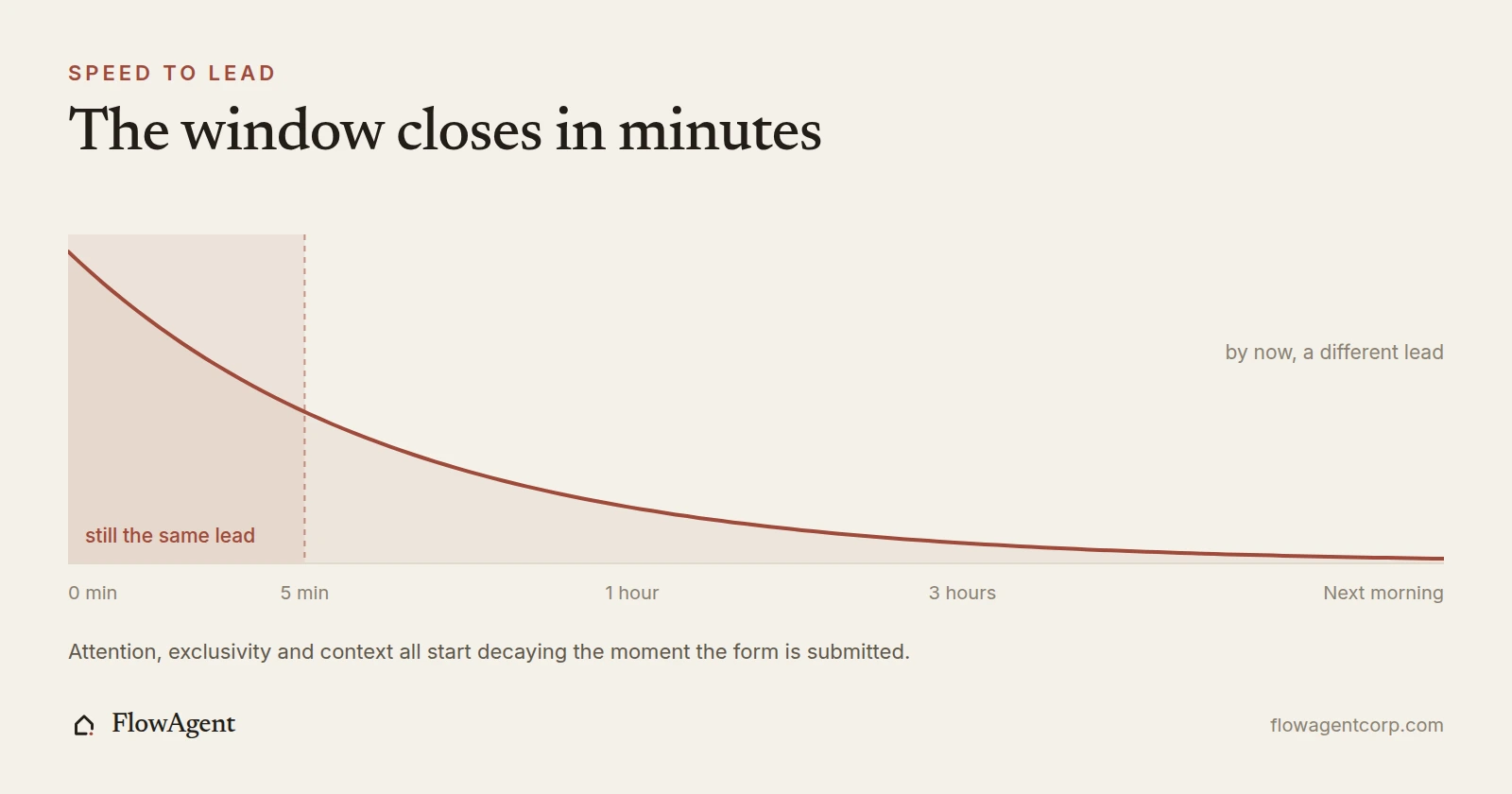
Two agents get the same lead at 9:14pm. One replies at 9:16pm. The other replies at 8:30 the next morning.
By 8:30 the next morning, it is not the same lead.
That is the whole of speed to lead. It is worth being precise about why, though, because the usual version of this advice — be fast, you will convert more — does not tell you what to do differently on Tuesday.
A lead is a moment, not a record
In your CRM a lead is a row. It has a name, an email, a source, a date. Rows do not decay. It is easy to work from the row and assume the person behind it is sitting still.
They are not. Somebody filled in that form because at 9:14pm on a Tuesday they were on their phone, looking at a house, and wanted to know something. That state — phone in hand, attention on this one property, curious enough to type — is the thing you are actually responding to. It lasts minutes.
Three things decay, and they decay at different speeds.
Attention. The tab is open now. In an hour it is closed. Tomorrow the person is at work and the question they had feels less urgent than it did on the sofa.
Exclusivity. Portal leads are rarely exclusive, and a buyer who is serious enough to enquire at 9pm is usually enquiring on more than one listing. You are not racing the clock. You are racing whoever else got the same notification.
Context. Right now they know exactly which house they meant and what they wanted to ask. Tomorrow you open with "Hi, I saw you enquired about a property" and they have to reconstruct which one. Every reconstruction is friction, and friction is where replies stop.
None of that is a conversion statistic. It is just what is true about a person who filled in a form at 9pm.
Fast and useless is still useless
The obvious fix is an autoresponder, and the obvious autoresponder makes things worse.
"Thanks for your interest! One of our agents will be in touch shortly." That message arrives in four seconds and does nothing, because it answers no question, offers no information, and asks for nothing. Worse, it spends the one moment you had. The person now knows they have been received by a system, and the reply you send at 8:30 the next morning arrives as the second contact rather than the first.
So speed on its own is not the goal. The goal is a useful first contact, delivered inside the window where it is still useful.
What the first message needs to contain
Four things, and it fits in four lines.
1. Proof you know which property. Name it. The address, or the street and the price. This is the single strongest signal that a human being with access to real information is at the other end, and it is the thing generic autoresponders cannot fake.
2. One piece of information they did not have. Something short and factual from the listing: it is still available, the HOA is $240 a month, there are two offers in, the sellers want a November close. Not a description — they read the description. Something that answers the question they probably had.
3. Exactly one question. Not six. A form that arrives as an interrogation gets abandoned. Ask the one whose answer changes what you do next — usually timeline, or whether they are also selling.
4. A specific next step. "Would Thursday 6pm or Saturday 10am work to see it?" beats "let me know if you would like to arrange a viewing." Two named options are easier to answer than an open invitation, and the reply tells you how serious they are.
Here is the whole thing:
Hi Dana — you asked about 14 Alder Street (the $475k colonial). It is still available, and the sellers are looking at a November close. Are you hoping to be in before then, or is your timing flexible?
I have Thursday at 6 or Saturday at 10 open if you would like to walk it.
Four lines. Names the property, carries a fact, asks one question, offers two times.
Do the arithmetic on your own pipeline
Rather than trusting a number from a study, count your own. Take last month:
- How many new leads arrived?
- How many got a reply within fifteen minutes?
- How many arrived outside 9 to 5?
Most agents who do this are surprised by the third number. Enquiries cluster in the evening, because that is when people look at houses. If your coverage stops at 6pm, the majority of your leads are landing in the gap.
Then the harder count: of the leads you answered the next morning or later, how many ever replied at all? That number is the cost of the gap, in your own market, in your own handwriting. It is more persuasive than anything anyone can tell you.
The part you cannot fix by trying harder
Speed to lead is one of the few problems in this job where effort is not the constraint. You are not slow because you are lazy. You are slow because the lead arrived while you were inside a showing, driving, at dinner, or asleep, and those are not things to fix.
That is the narrow gap worth automating: the first reply, on the leads that arrive when you are not there. It is the piece that is mechanical — name the property, carry one fact, ask one question, offer two times — and it is the piece where being late costs the most.
FlowAgent does that part. It answers a new lead in minutes at any hour with real listing data, asks the qualifying question, offers times from your actual calendar, and hands you the conversation the moment it stops being mechanical. What it is not is a replacement for the conversation that follows, and any tool that claims otherwise is selling you something.
If you would rather not use anything, the manual version still works: a saved reply template with a blank for the address and the fact, and a rule that new leads get it before you do anything else.
What to measure once you have changed something
Two numbers, monthly.
Median time to first reply. Median, not average — one lead you answered three days later will drag an average into uselessness while hiding that most are fine.
Reply rate on first contact. The share of new leads who answer your first message. (For the ones who answer once and then stop, that is a different problem with a different fix.) This is the number that tells you whether the message is any good, separately from whether it was fast. If you get faster and this does not move, the problem was never the timing.
Speed is the cheap half. It only pays once the message that arrives quickly is worth having received.