Four Questions That Qualify a Real-Estate Lead (and Two You Must Not Ask)
A short qualifying script that sorts a new lead without reading as an interrogation, plus the questions Fair Housing puts off-limits and what to say instead.
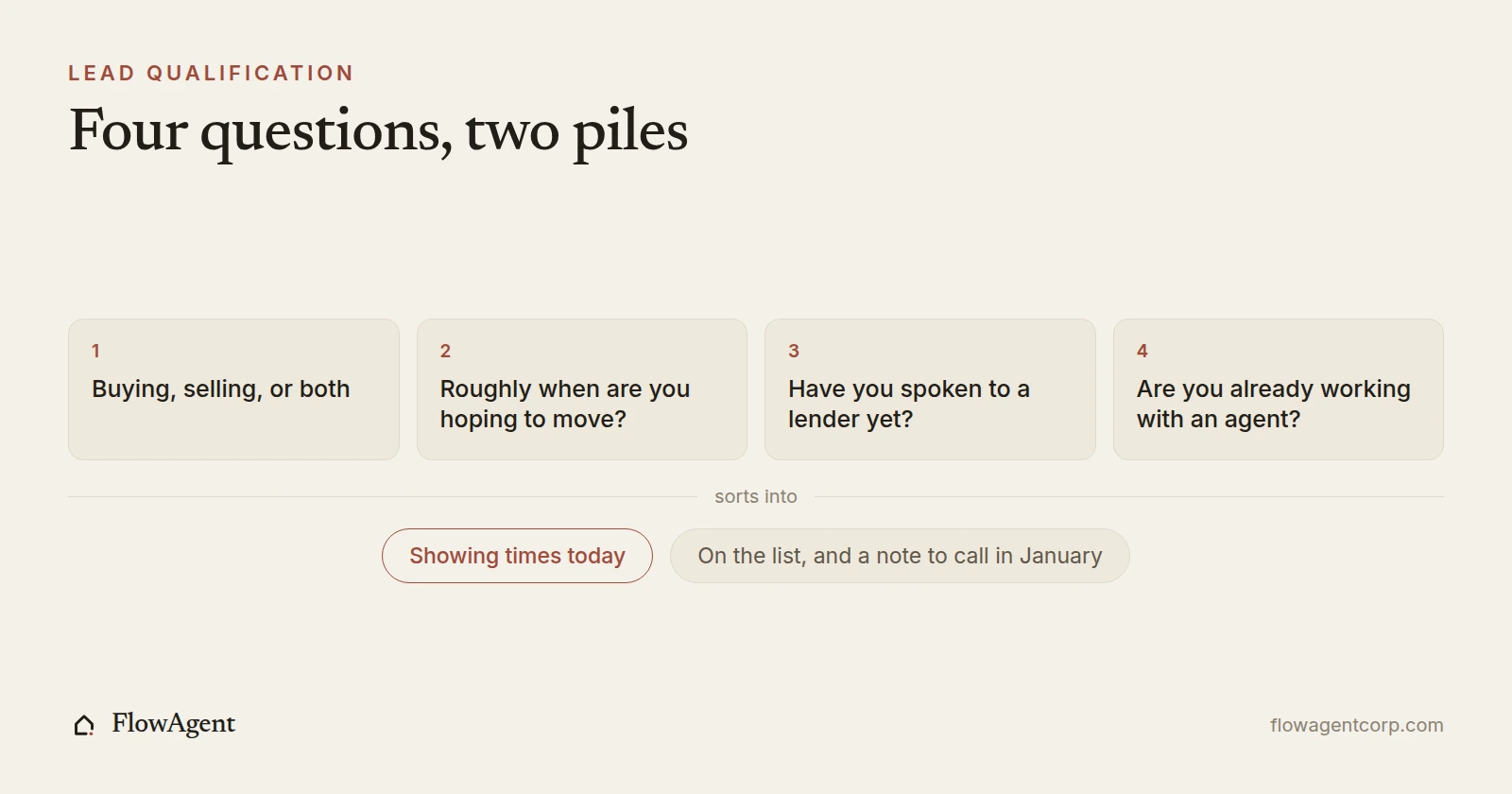
Most qualifying scripts are too long. They read like a form, they arrive as an interrogation, and a lead who was willing to answer one question abandons six.
The useful version is shorter than you would expect, and the interesting part is not which questions to add. It is which ones you have to leave out, because two of the questions agents ask most naturally are the ones Fair Housing puts off-limits.
What qualifying is actually for
Not to decide whether someone deserves your time. To decide what you do next, and in what order.
A lead who is pre-approved and needs to move in six weeks and a lead who is browsing for next spring are both real. They are not the same next action. One gets showing times today. The other gets added to a list and a note to call in January. Qualifying is the sorting step, and the only questions worth asking are the ones whose answers change the sort.
That is a useful filter. Before you add a question, ask what you would do differently depending on the answer. If nothing, cut it.
The four
1. Buying, selling, or both.
Obvious, and frequently skipped because the lead source implies it. A portal enquiry on a listing looks like a buyer. Perhaps a third of the time it is somebody who needs to sell first, and that is a completely different conversation with a completely different timeline — and often twice the transaction.
Ask it as: "Are you looking to buy, or is there a place you need to sell first?"
2. Timeline.
The single most informative answer you will get. It sorts your pipeline by itself, and it is the question people answer honestly because it costs them nothing.
Ask it as: "Roughly when are you hoping to move?"
Not "are you ready to buy today?", which is transparently a qualifying question and invites a defensive answer.
3. Financing, for a buyer. Motivation, for a seller.
For a buyer this is the difference between a showing and a wasted Saturday. You are not asking for numbers. You are asking whether they have spoken to anyone yet.
Ask it as: "Have you spoken to a lender yet, or would it help if I introduced you to one?"
The second half matters. It turns a screening question into an offer, and the answer is useful either way: yes means they are further along than most, no means you have something to give them.
For a seller, the equivalent is why and when. "What is prompting the move?" tells you whether you are dealing with a deadline or an idea.
4. Whether they are already working with someone.
Ask early. Asking on the second showing is worse for everyone, and in most places representation is not a thing you want to discover late.
Ask it as: "Are you already working with an agent?"
That is the whole script. Four questions, and you do not ask all four in the first message — the first message asks one, usually timeline, and the rest come out across a normal conversation.
The two you must not ask
Here is the part that gets skipped in most advice on this, and it is the part with actual consequences.
The Fair Housing Act prohibits discrimination on the basis of race, color, religion, sex, national origin, familial status, and disability. Familial status means whether there are children in the household. In practice, the rule most agents run into is not about refusing to work with someone. It is about steering — directing buyers toward or away from areas based on a protected characteristic. That includes doing it helpfully, and it includes doing it because the buyer asked you to.
Do not ask whether they have children.
It sounds like small talk and it is the single most common way agents create a familial-status problem. The moment it is in the thread, any subsequent neighborhood suggestion can be read as steering. If you need to know how many bedrooms, ask how many bedrooms.
Do not ask what kind of neighborhood or what kind of people they want to be around.
This sounds like discovery and it is an invitation. If the answer comes back in demographic terms, you now have a request you cannot act on and a written record of it. Ask about the things you can legitimately act on instead: commute, budget, property type, lot size, number of bedrooms, whether they want an HOA.
Three answers you need ready
Steering usually does not start with you. It starts with a reasonable-sounding question from a buyer, and the damage is done in a helpful reply. These three come up constantly:
"Is it a safe area?"
Do not characterize it. Not "very safe", not "it has its moments". Both are opinions about an area's population and both are the kind of statement Fair Housing cases are built on.
Say: "I am not able to characterize areas that way, but the police department publishes incident data by district and I can send you the link so you can look at the exact streets you are considering."
"How are the schools?"
Same shape. School quality is a well-worn proxy for demographics, and a rating repeated by an agent becomes the agent's claim.
Say: "I do not rate schools, but GreatSchools and the state department of education both publish the data by catchment, and I can tell you exactly which catchment each of these addresses falls into."
That second half is the point. You are not stonewalling — you are handing over a better source than your opinion, and the catchment lookup is something you can genuinely do that they cannot.
"What kind of people live around there?"
There is no version of answering this that ends well.
Say: "I am not able to describe neighborhoods by who lives in them — that is a Fair Housing rule and it applies to every agent. What I can do is tell you about the property, the HOA, the commute, and what has sold on that street this year."
Nobody has ever ended a relationship with an agent over that answer. Plenty of agents have ended up in a complaint over the alternative.
Write it down before you need it
The reason steering happens is not that agents intend it. It is that the question arrives mid-conversation, you are being helpful, and the helpful answer is the wrong one. Deciding your response in advance is most of the fix.
It is also why we built the Fair Housing check in FlowAgent as a deterministic filter on outgoing messages rather than only an instruction to the model. An instruction is followed most of the time. A message that says "great area for families" or characterizes crime gets held for the agent to look at, every time, because most of the time is not a standard that works for a rule with legal weight.
The four questions sort your pipeline. The two you leave out are the ones that keep the sorting from becoming a problem.
This is general information about a compliance area, not legal advice. State and local law adds protected classes beyond the federal list — source of income and sexual orientation in many places — so check what applies where you practice, and ask your broker.