What to Send When a Real-Estate Lead Goes Quiet
A follow-up sequence for leads that stop replying: what each message has to carry, how far apart to send them, and when to stop.
A lead replies twice, sounds interested, agrees that Saturday could work — and then nothing. No reply to your next message, or the one after.
Most agents read this as a no. It usually is not. It is the most common state a live lead can be in, and the reason it feels like rejection is that silence looks identical whether someone has bought a house with somebody else or simply had a bad week.
Why they actually stopped
Worth separating, because the response is different.
They got busy. The overwhelming majority. Buying a house is important and not urgent, which is exactly the category of task that loses to everything urgent and unimportant.
They hit a blocker they are embarrassed about. The pre-approval came back lower than expected. Their own place needs work before it can list. A partner is not on board. People do not announce these. They go quiet.
Their timeline moved. The job did not come through, or the school year made spring better than autumn. Still a real lead, just not this quarter.
They are working with someone else. A minority, and the only one where the right answer is to stop. (Asking early is one of the four qualifying questions, precisely so you find this out before week six.)
You cannot tell which from the outside. What you can do is send messages that are useful in all four cases, which turns out to be a strong constraint on what to write.
The rule that fixes most follow-up
Every message must carry something new.
"Just checking in" carries nothing. "Following up on my last email" carries nothing and adds a note of reproach. "Are you still interested?" carries nothing and asks the recipient to do the work of restarting the conversation, which is why it so often gets no reply.
New information means: a price change, a new listing that fits what they said, something that sold on the street they liked, a change in rates, an open house on a place they mentioned. If you have nothing new, that is not a signal to send nothing — it is a signal to go find something, which takes about four minutes in the MLS.
This one rule does most of the work. It also naturally paces you, because you cannot send new information every day.
A sequence that works
Days are from the last time they replied, not from first contact.
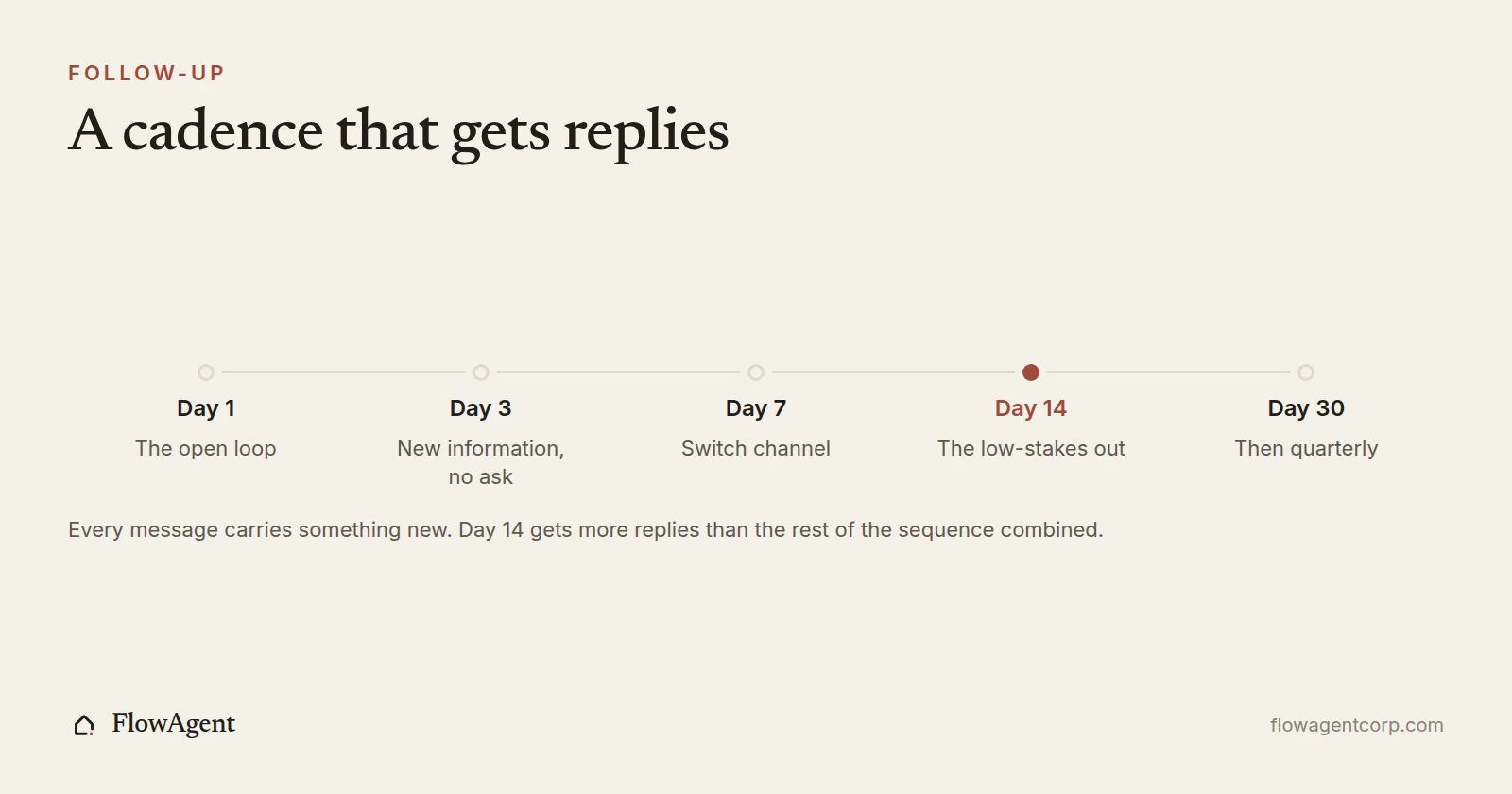
Day 1 — the open loop. Answer whatever was outstanding, and leave exactly one thing hanging that requires them. "I checked with the listing agent — the sellers will consider a December close. Do you want me to put Saturday on hold?"
Day 3 — new information, no ask. Send something relevant and explicitly require nothing. "14 Alder dropped to $459. Not pushing, just thought you would want to know." Removing the ask is what makes this one get replies. There is no obligation attached, so there is nothing to put off.
Day 7 — the channel switch. If they came in by email, call. If they have been texting, email. Not because one channel is better, but because the one you have been using has visibly stopped working. Keep it to one voicemail, and say something specific in it.
Day 14 — the low-stakes out. "Are you still looking, or has this gone on the back burner for now? Either is completely fine — I just do not want to keep sending listings if the timing has changed."
This gets more replies than anything else in the sequence, and the reason is that it makes "not right now" easy to say. A lead who has been feeling vaguely guilty about ignoring you is relieved to have a graceful exit, and a surprising share of the replies are not "stop" but "sorry, yes, still looking — things got busy."
Day 30, then quarterly. Slow to something sustainable. One genuinely relevant thing a quarter — a sale on their street, a market note for their area. This is the part almost everyone drops, and it is where a meaningful number of transactions come from twelve or eighteen months later.
Stop when they say stop
Not a tactic. In the US, texting and calling leads is governed by TCPA and by do-not-call rules, and an opt-out has to be honored promptly and across the board — not just on the channel where they said it.
So: if somebody replies STOP to a text, they are out of email too. If they say on the phone that they are not interested, that goes in the CRM as an opt-out, not as a note to try again in a month. Keep every message you send identifiable and easy to opt out of.
Beyond compliance, the quarterly cadence only survives because it is genuinely easy to leave. A list people cannot get off is one they mark as spam, and that costs you deliverability with everyone else on it.
The part that actually fails
The sequence above is not difficult. Nobody disagrees with it. It still does not happen, and the reason is arithmetic.
Forty live leads, each with a different last-contact date, each needing a different next message at a different interval, all tracked alongside the transactions that are actually closing — and the transactions win, because they have deadlines and the follow-up does not. The leads that go quiet are precisely the ones with nobody chasing the calendar.
So the fix is not discipline. It is that the open loops have to live somewhere other than your memory. A spreadsheet with a next-contact date works. A CRM with tasks works, if you actually clear the tasks. FlowAgent tracks the open loops and sends the sequence itself, handing the thread back when somebody replies with something that needs you — which is the point at which it stops being mechanical.
Whatever you use, the test is the same: pick a lead who went quiet six weeks ago and see whether anything would have gone out without you remembering. If the answer is no, that is the gap, and it is not a motivation problem.
One number to watch
Of the leads that went quiet this quarter, how many replied to something later?
If it is zero, either nothing is going out or what is going out carries no new information. Both are fixable this week, and the second one is usually the real cause.